

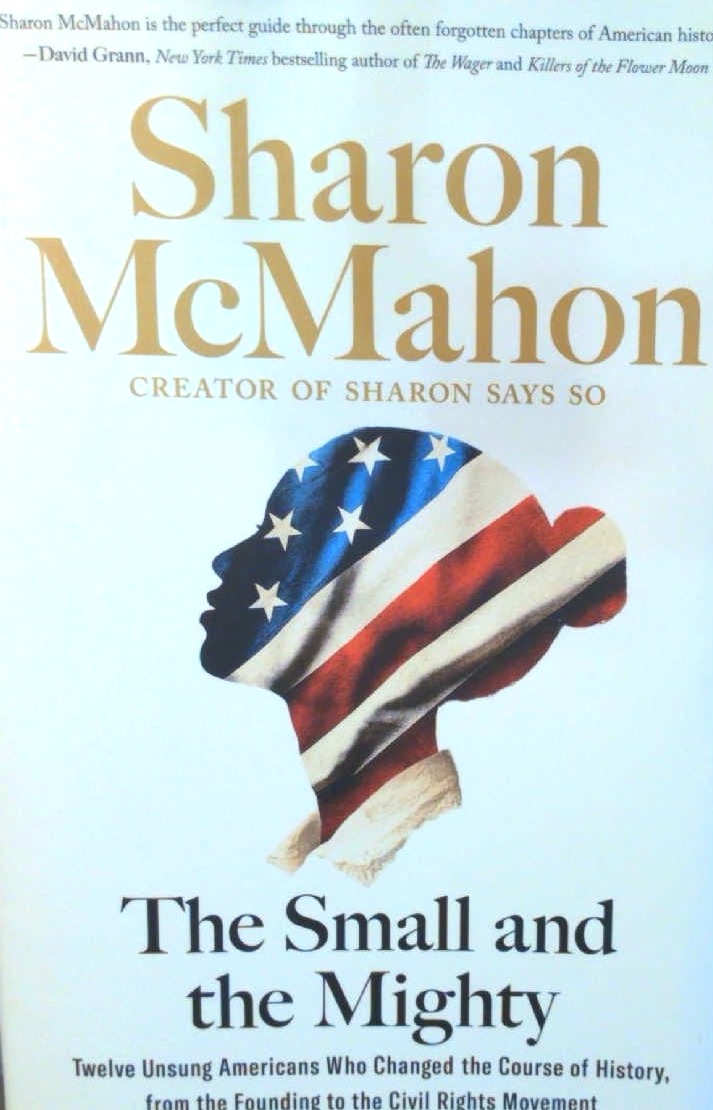
As stirring as her podcast, with rigorous research and an enjoyable reading style. You will never forget these 12 men and women who shaped the United States. Most of them, I bet, you have not heard of before, as vividly told in Sharon’s life.
This selection is one place where she connects the lives of people from the 19th and 20th centuries to struggles we face today. I am receiving training from Matthew 5:9 Fellowship in being a peacemaker. I have found that it has helped me define the dominance of fear in the church and the society around me. I WELCOME YOUR COMMENTS. Roy King April 18, 2025
PAGES 243-245 THE SMALL AND THE MIGHTY
Then and now, one of the most effective ways to stop cultural change is to create a moral panic around it. Moral panics have been around since this country’s inception, with the Salem witch trials being among the first widely publicized (and deadly) panics. Since then, moral panics have been used as a tool to subvert and dismantle movements that the dominant caste views as a threat. And this included civil rights.
Sociology professors Erich Goode and Ben-Yehuda Nachman have identified five stages of moral panic, which they describe as “culturally and politically constructed, a product of the human imagination.” 15
1. Concern: An event occurs that raises someone’s sense of alarm.
2. Hostility: A group or subculture is then looked on with disdain or aggression as a result of the concern.
3. Consensus: The dominant group builds agreement that the group or subculture is the cause of the concern, and that they are justified in their hostility toward them.
4. Disproportionality: The threat of harm posed by the group or subculture is then exaggerated for effect.
5. Volatility: The moral panic erupts, and/or dies down when it is replaced with another moral panic.
In the 1940s and ’50s, the quickest way to sink an activity you didn’t like was to include it in the broad moral panic surrounding communism, which we now call the Red Scare.
Civil rights? Communism.
The NAACP? Communism.
Highlander Folk School? Communism.
Martin Luther King? Communist.
Myles Horton? Communist.
Clifford Durr? Communist.
Eleanor Roosevelt? Communist.
Civil rights leader Dorothy Cotton remembered that there was a “large billboard on a major highway with Mrs. Eleanor Roosevelt’s photograph, and that of Dr. Martin Luther King, with a caption indicating that they were ‘at that communist school’ in Tennessee,
Determined to capitalize on the threat of communist infiltration, South Carolina made it illegal for any government employees to be a member of the NAACP. Septima wasn’t having any of that nonsense. (Dorothy Cotton later reported that, at Myles Horton’s funeral in 1990, the fact that civil rights work was viewed as communism was joked about. “They wouldn’t know communism from rheumatism,” Horton’s friends laughed. When employees were required to fill out a form listing all their group memberships and attesting that they were not in the “communist” NAACP, Septima refused to hide her membership. She knew it was likely that she would be terminated, but she was unwilling to live a lie.
And she was terminated by the Charleston Public Schools. Which only gave her more time to devote to her activism. She didn’t have time to sit around being angry, not when there was so much to be done. “You know the measure of a person is how much they develop in their life,” she said. “Some people slow down in their growth after they become adults. But you never know when a person is going to leap forward or change completely—I’ve seen growth that most people don’t think possible. I can even work with my enemies because I know from experience that they might have a change of heart any minute.”1
If I were a preacher or motivational speaker, I would have exclaimed Septima’s words in a fever pitch. Then I would drop my voice to barely above a whisper, repeating in staccato what you just heard for emphasis. “I can even work with my enemies because I know from experience. that…” My voice would swoop back up, projecting to the back of the room: “THEY MIGHT HAVE A CHANGE OF HEART ANY MINUTE! At any minute!” My arms would move wildly, underscoring what it is we should all walk out of the room knowing: “How can our enemies have a change of heart if we don’t work with them? How can they be convinced that they’re on the wrong path if we cut them out of our lives? How can we possibly hope to influence someone with whom we have no relationship?”
And then, I would get close to the microphone, my body still. “They can’t,” I would whisper. “They CAN’T. Your enemy won’t change cause you refuse to sit with them at a dinner table! We have but one hope, one hope,” I would repeat. “The hope that change is always possible if we refuse to give up on people!” My speech/sermon would probably go on to give other examples of people who saw extraordinary change only after they persevered in the face of extraordinary adversity.
And then at the end, I would come back to Septima’s message. I would repeat the hope that she did not feel, but that she chose. I would remind the audience that Septima was fired from her job. She was denied equal pay and job opportunities. I would remind them that her students were learning in the dark with no books. I would say that her baby died and her husband was a liar and that she nearly perished, over and over and over, that people tried to kill her, but still, she refused to give up on her enemies. “WHY?” I would ask. “WHY? Because she knew that her enemies might have a change of heart at any minute. Any minute. But only if she stayed in the game. Only if she refused to give up hope.” And then I would hope that the audience would leave my talk encouraged by the idea that their labors are not in vain. That, despite current evidence to the contrary, their enemies were capable of change. But only if they refused to quit. Only if they chose to hope.
Septima, who had already attended a workshop at Highlander, began teaching there after she was fired from Charleston Public Schools. Rosa Parks was one of her students, and Parks later took what she learned at Highlander and became the face of a movement. Septima went on to develop an educational program that you may have never heard of. But it became a cornerstone of the civil rights movement.


 Assisting others in being effective, vibrant followers of Jesus by providing Coaching, Consulting, and Training
Leave a comment